KT0404: Limitations of the various types of bushes and bearings
Bearing service life
The service life of the bearing is affected by many factors that the bearing manufacturers do not control. For example, bearing mounting, temperature, exposure to the external environment, lubricant cleanliness, and electrical currents through bearings. High-frequency PWM inverters can induce electric currents in a bearing, which the use of ferrite chokes can suppress. The temperature and terrain of the micro-surface will determine the amount of friction by touching solid parts. Certain elements and fields reduce friction while increasing speeds. Strength and mobility help determine the load the bearing type can carry. Alignment factors can play a damaging role in wear and tear, yet overcome by computer aid signaling and non-rubbing bearing types, such as magnetic levitation or airfield pressure.
Fluid and magnetic bearings can have practically indefinite service lives. In practice, fluid bearings support high loads in hydroelectric plants that have been in nearly continuous service since about 1900 and show no signs of wear.

Rolling element-bearing life is determined by load, temperature, maintenance, lubrication, material defects, contamination, handling, installation, and other factors. These factors can all have a significant effect on bearing life. For example, the service life of bearings in one application was extended dramatically by changing how the bearings were stored before installation and use, as vibrations during storage caused lubricant failure even when the only load on the bearing was its weight; the resulting damage is often false brinelling. Bearing life is statistical: several samples of a given bearing will often exhibit a bell curve of service life, with a few samples showing significantly better or worse life. Bearing life varies because microscopic structure and contamination vary greatly, even when macroscopically, they seem identical.
Bearings are often specified to give an “L10” (US) or “B10” (elsewhere) life, the duration by which ten percent of the bearings in that application can be expected to have failed due to classical fatigue failure (and not any other mode of failure such as lubrication starvation, wrong mounting, etc.), or, alternatively, the duration at which ninety percent will still be operating. The L10/B10 life of the bearing is theoretical and may not represent the service life of the bearing. Bearings are also rated using the C0 (static loading) value. This is the primary load rating as a reference and not an actual load value.

For plain bearings, some materials give a much longer life than others. Some of the John Harrison clocks still operate after hundreds of years because of the lignum vitae wood employed in their construction, whereas his metal clocks seldom run due to potential wear.
Flexure bearings rely on the elastic properties of a material. Flexure bearings bend a piece of material repeatedly. Some materials fail after repeated bending, even at low loads, but careful material selection and bearing design can make flexure bearing life indefinite. Depending on the customised specifications (backing material and PTFE compounds), composite bearings can operate for up to 30 years without maintenance. For bearings that are used in oscillating applications, customised approaches to calculate L10/B10 are used.
Many bearings require periodic maintenance to prevent premature failure, but others require little maintenance. The latter include various kinds of polymer, fluid, and magnetic bearings, as well as rolling-element bearings that are described with terms including sealed bearing and sealed for life. These contain seals to keep the dirt out and the grease in. They work successfully in many applications, providing maintenance-free operation. However, some applications cannot effectively use them.
Non-sealed bearings often have a grease fitting for periodic lubrication with a grease gun or an oil cup for periodic filling with oil. Before the 1970s, sealed bearings were not encountered on most machinery, and oiling and greasing were a more common activity than they are today. For example, automotive chassis used to require “lube jobs” nearly as often as engine oil changes, but today’s vehicle chassis are mostly sealed for life. From the late 1700s through the mid-1900s, industry relied on many workers called oilers to lubricate machinery frequently with oil cans.
Factory machines today usually have lube systems in which a central pump serves periodic charges of oil or grease from a reservoir through lube lines to the various lube points in the machine’s bearing surfaces, bearing journals, pillow blocks, and so on. The timing and number of such lube cycles are controlled by the machine’s computerised control, such as PLC or CNC, as well as by manual override functions when occasionally needed. This automated process is how all modern CNC machine tools and many other factory machines are lubricated. Similar lube systems are also used on nonautomated machines, in which case there is a hand pump that a machine operator is supposed to pump once daily (for machines in constant use) or once weekly. These are called one-shot systems from their chief selling point: one pull on one handle to lube the whole machine instead of a dozen pumps of an alemite gun or oil can in a dozen different positions around the machine.
The oiling system inside a modern automotive or truck engine is similar in concept to the lube systems mentioned above, except that oil is pumped continuously. Much of this oil flows through passages drilled or cast into the engine block and cylinder heads, escaping through ports directly onto bearings and squirting elsewhere to provide an oil bath. The oil pump pumps constantly, and any excess pumped oil continuously escapes through a relief valve back into the sump.
Many bearings in high-cycle industrial operations need periodic lubrication and cleaning, and many require occasional adjustment, such as pre-load adjustment, to minimise the effects of wear.
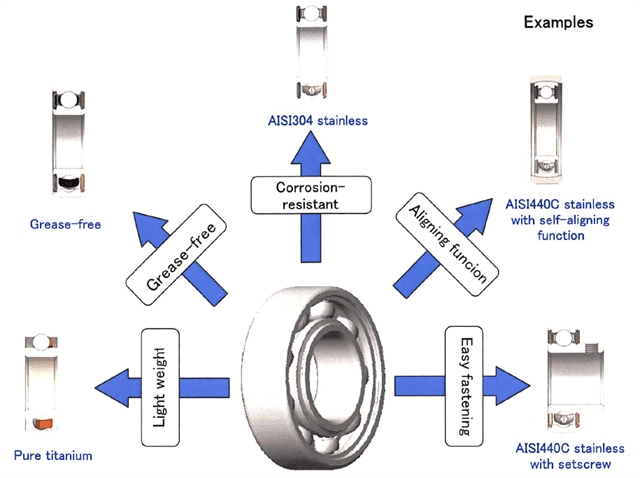
Bearing life is often much better when the bearing is kept clean and well-lubricated. However, many applications make good maintenance difficult. One example is bearings in the conveyor of a rock crusher, which are exposed continually to hard abrasive particles. Cleaning is of little use because cleaning is expensive, yet the bearing is contaminated again as soon as the conveyor resumes operation. Thus, a good maintenance program might lubricate the bearings frequently but not include any disassembly for cleaning. The frequent lubrication, by its nature, provides a limited kind of cleaning action by displacing older (grit-filled) oil or grease with a fresh charge, which itself collects grit before being displaced by the next cycle. Another example is bearings in wind turbines, which makes maintenance difficult since the nacelle is placed high up in the air in strong wind areas. In addition, the turbine does not always run and is subjected to different operating behavior in different weather conditions, which makes proper lubrication a challenge.
Bearing limitations
Precision ball bearings are designed to have a long and useful Iife. Bearings have their limitations, and we need to make sure:
- Use the correct bearing for the application, e.g., Do not fit a thrust bearing where a roller bearing is required.
- Make sure bearings are not working in poor operating conditions.
Disadvantages/limitations of plain bearings
- High load-speed combinations generate too much heat.
- Tilting moments with offset drives is difficult.
- Higher drive torques are required in some cases.
- Bearing clearance mandatory.
- Not suitable for mass production.
- Interchangeability is not good.
- It is not easy to install, disassemble, and repair.
- Additional cooling/heat dissipation is required depending on design and application.
Disadvantages/limitations of deep groove ball bearings
- Limited load capacity compared to other bearing types.
- Less suitable for applications with high axial loads or heavy shock loads. More noise during operation (especially at high speeds).
Disadvantages/limitations of angular ball bearings
- Require accurate alignment for optimal performance.
- Increased friction compared to deep groove ball bearings.
- Higher cost compared to some other bearing types.
Disadvantages/limitations of cylindrical roller bearings
- Increased friction compared to ball bearings.
- Higher cost and more complex design.
- Require careful lubrication to prevent premature wear.
Disadvantages/limitations of tapered roller bearings
- Increased friction compared to ball bearings.
- Require precise mounting and adjustment.
- Higher cost and more complex design.
Disadvantages/limitations of spherical roller bearings
- Increased friction compared to ball bearings.
- Higher cost compared to some other bearing types.
- Additional axial support is required in some cases.
Disadvantages/limitations of roller bearings
- More noise during operation (especially at high speeds).
- Higher initial cost.
- Low resistance to shock loading.
- Wear during standstill (pitting).
- The design of bearing housing is complicated.
Disadvantage/limitation of thrust ball bearing
Thrust bearings are used to support axial loads, but they are limited in their ability to support radial loads. This means that they cannot be used for applications where radial loads are present.
It’s important to note that the limitations/disadvantages listed above are generalisations, and specific applications may have unique requirements that can impact the suitability of each bearing type. It is recommended that bearing manufacturers and engineers consult to select the most appropriate bearing type for a particular application.