In porttitor ipsum eu justo condimentum euismod ullamcorper viverra.

The bearings that support the shafts of motors and pulleys are subject to a radial load.
Bearings typically face two kinds of loading: radial and thrust. Depending on where the bearing is being used, it may see all radial loading, all thrust loading, or a combination of both. The bearings in the electric motor and the pulley pictured above face only a radial load. In this case, most of the load comes from the tension in the belt connecting the two pulleys.

The bearings in this stool are subject to a thrust load.
The bearing above is like the one in a barstool. It is loaded purely in thrust, and the entire load comes from the weight of the person sitting on the stool.
The bearings in a vehicle wheel are subject to both thrust and radial loads
The bearing above is like the one in the hub of your vehicle wheel. This bearing has to support both a radial load and a thrust load. The radial load comes from the weight of the vehicle; the thrust load comes from the cornering forces when you go around a turn.

Bearings make the rotation of objects smooth. Bearings are made up of components that allow two surfaces to roll over each other while also reducing friction. Balls or rollers act as rolling elements between races of the bearing assembly. Because of their round shape, bearings support radial (forces from above and below), axial (lateral), combined (radial and axial), and moment (tilting) forces.
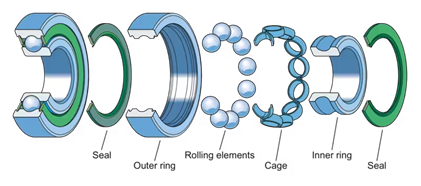
A typical rolling bearing consists of the following components:
A cage.
An inner ring.
An outer ring.
Balls or rollers, as rolling elements.
There are several different bearing types. Bearings capped on both sides are factory-filled with grease. Compared to external sealing, they provide an economical and space-saving solution.
Bearing internal clearance is defined as the total distance through which one bearing ring can be moved relative to the other in the radial direction (radial internal clearance) or the axial direction (axial internal clearance).

In almost all applications, the initial clearance in a bearing is more significant than its operating clearance. Two effects mainly cause the difference:
Sufficient internal clearance in a bearing during operation is essential. Preload (clearance below zero) is possible for certain bearing types. Bearings are available in different clearance classes to enable the selection of the appropriate initial internal clearance to achieve the desired operational internal clearance. ISO has established five clearance classes for many bearing types.
| ISO clearance class | Internal clearance |
| Group 2 | Smaller than normal |
| Group N | Normal |
| Group 3 | Greater than normal |
| Group 4 | Greater than Group 3 |
| Group 5 | Greater than Group 4 |
Rolling bearing rings and rolling elements must:
This is achieved through heat and surface treatments.
a. Hardening
Three typical hardening methods may be applied to bearing components:
b. Dimensional stability
Heat treatment is used to limit dimensional changes caused by metallurgical effects at extreme temperatures. There is a standardised classification system for dimensional stability. The various SKF bearing types are stabilised to different classes as standard.
c. Surface treatment and coatings
Coating is a well-established method for providing bearings with additional functional benefits to accommodate specific application conditions. Widely used coatings are zinc chromate and black oxide.
Two other methods developed by SKF have proven successful in many applications:
Boundary dimensions are the main dimensions of a bearing. They comprise of:
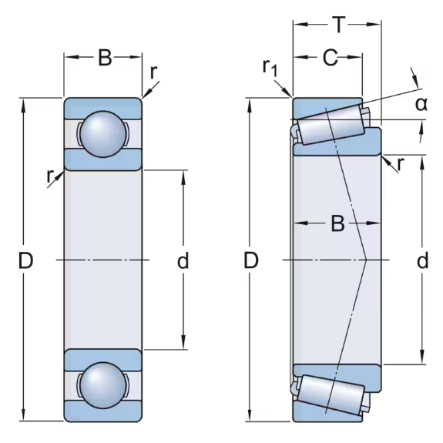
Boundary dimensions radial bearing
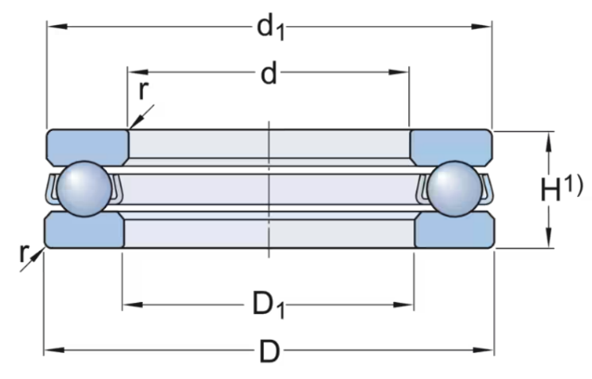
Boundary dimension thrust bearing
A bushing or plain bearing is a cylindrical part used to reduce friction between components. Unlike a bearing, a bushing, often referred to as a sleeve, is a single piece. Though bushings and bearings are in similar categories, they’re not interchangeable, and they don’t move in the same way. Bushings slide while bearings roll. Bushings are ideal for distributing the weight of heavy or high load-bearing tolerances. They act as shock absorbers and decrease noise and wear. Many are self-lubricating, saving labour and time. Reservoirs on the surface hold grease or oil and spread it automatically when used. In the food and textile industries, factories use non-lubricating or dry bushings.
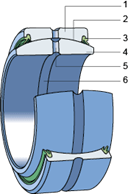
1. Outer ring
2. Sliding contact surfaces
3. Seal
4. Inner ring
5. Lubrication hole
6. Lubrication groove
Spherical plain bearing (Bushing)

1. Spherical Plain Bearing
2. Rod end
2a. Rod end housing
2b. Rod end shank, with an external (male) thread. Shanks are also available with an internal (female) thread or with a welding shank
3. Grease fitting
Rod end

In porttitor ipsum eu justo condimentum euismod ullamcorper viverra.

Lorem ipsum dolor sit amet, consectetur adipiscing elit pellentesque porta.

Repellat perspiciatis cum! Doloremque ea viverra eu doloremque.

Lorem ipsum dolor sit amet, consectetur adipiscing elit. Etiam malesuada laoreet erat. Curabitur tempor orci eget mollis volutpat. Quisque et velit ligula.

Lorem ipsum dolor sit amet, consectetur adipiscing elit. Etiam malesuada laoreet erat. Curabitur tempor orci eget mollis volutpat. Quisque et velit ligula.

Lorem ipsum dolor sit amet, consectetur adipiscing elit. Etiam malesuada laoreet erat. Curabitur tempor orci eget mollis volutpat. Quisque et velit ligula.

Lorem ipsum dolor sit amet, consectetur adipiscing elit. Etiam malesuada laoreet erat. Curabitur tempor orci eget mollis volutpat. Quisque et velit ligula.

Get started with LearnDash in this course.